

How to Stay Motivated in College: 9 Practical Tips
You’re sick and tired of waking up early to go to class and staying up late to study. The last thing you feel like doing is reading another article, writing another paper, taking another test, doing another project. The only reason you can imagine opening your laptop is to binge-watch your favorite streaming show.
You have lost every ounce of motivation to do college. Does this sound familiar? If so, you’re in good company!
The struggle to stay focused and maintain the energy you need to get to the finish line – whether it’s at the end of the term, the year, or graduation – is real! After decades of teaching, mentoring, and coaching thousands of undergrads as a professor and coach, I can tell you that the greatest challenge students experience is staying motivated. Every student struggles in some way, at some point, with the consistent focus, commitment, and responsibility college requires.
But there is a path to building and maintaining motivation that will see you through these rough patches. It’s paved with tools that will support you intellectually, physically, and psychologically.
In this article, you’ll learn a bit about why you may be struggling with motivation and tools you can use to develop and preserve your energy and focus to keep you motivated throughout the term. You’ll also find links to inspirational thoughts and positive self-talk that are important elements for psychological health and critical thinking.

Why am I lacking motivation in college?
There are many valid reasons you may be running out of motivation in college. Put simply, being a college student is hard! Every term and year brings new opportunities and challenges that can be fun and exciting, but also scary and draining. For example, you’re away from home and missing loved ones, living with strangers, trying to build a social network, juggling everything that comes with college, figuring out what comes after graduation, and generally being responsible for many aspects of your current and future life.
Trying to manage all of this at once can be overwhelming, so it makes sense to want to hide under the covers and never come out. Fortunately, there are tools to manage all of this without feeling so weighed down.
How to Stay Motivated in College
Staying motivated in college isn’t about huge breakthroughs. It’s about small, practical habits that help you manage stress, stay focused, and reconnect with your purpose.
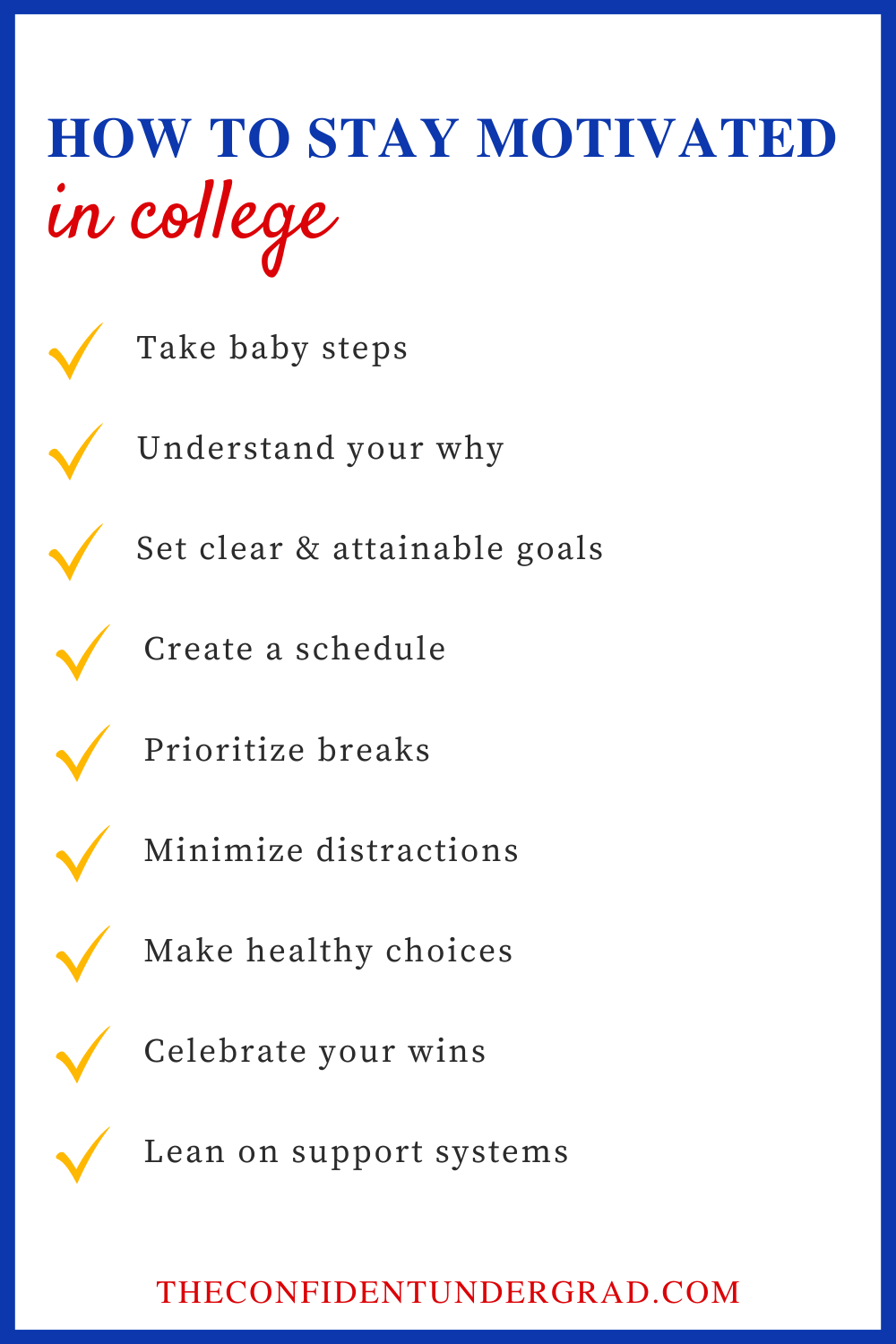
1. Take Baby Steps
Because so much of being unmotivated in college comes from feeling overwhelmed and tired, the most important thing you can do is take small, slow steps towards your goal(s).
Whether you’re in your first year or navigating later semesters, there’s a lot to juggle and many decisions to make. This makes it easy to feel rushed, frantic, or buried under it all.
A few simple tools for managing the pressure you may feel include:
Breathe – Pause and take a few slow, deep breaths to calm your nervous system.
Do one tiny task – Check off even the smallest item to regain a sense of momentum.
Use a mantra – Repeat a positive phrase, saying, or prayer to reset your mind.
Dump your thoughts – Jot down how you feel in a journal, Notes app, or a quick voice memo.
Reach out – Call or text a friend, sibling, parent, or anyone you trust to share the burden.
2. Understand Your Why
Your “why” is the reason(s) behind what you’re doing. Without one, it’s easy to drift without direction – taking classes you don’t enjoy, majoring in something you’re not connected to, struggling to form the right social circles, and generally feeling unsure about what you’re doing in college in the first place. That lack of purpose is one of the fastest paths to feeling unmotivated.
Taking the time to learn what matters to you, draws your attention, gives you focus and energy, and makes you fulfilled creates a sense of stability and direction. It becomes the motivation to keep you going, especially when times get hard.
Among the ways to learn more about what you care about are:
Identify your core values - Values are guiding principles like empathy, justice, nature, creativity, or service. There are long lists online, which can feel overwhelming, so take baby steps. Choose one or two that stand out and consider how they can guide your major, your time, and your choices.
Connect moods to tasks - For one week, note how you feel while doing different tasks – energized, joyful, annoyed, tired, frustrated, relaxed, etc. You won’t and can’t feel good all the time, but identifying what consistently makes you feel the best about yourself will help you choose a positive and productive direction.
Consider your perfect day - If you could design an ideal day filled with the things you love, what would it look like? This helps you clarify what brings you joy and may inspire ways to add meaning to your current days and long-term plans.
3. Set Clear & Attainable Goals
Our “why” sets us in motion and gives us direction, and goals give us targets that help our motivation. Like many things, goal-setting can be overwhelming, so don’t make it a bigger deal than it needs to be. We want the process of goal-setting and our goals to be doable. Remember, baby steps!
Consider the following tips for setting clear and attainable goals:
Choose one thing - Avoid trying to do everything all at once. Instead, pick one task you want to accomplish today, next week, by the end of the term, and/or before the end of the school year.
Connect it to your why - Setting a goal related to one of your core values, a task that gives you energy or joy, or that helps you achieve part of your perfect day will be easier to achieve, make you feel good about yourself, and motivate yourself to continue setting goals.
Treat yourself - Everyone has trouble meeting their goals sometimes. To increase the likelihood that you’ll achieve yours is to reward your accomplishment. It can be as simple watching a show you haven’t had time for or eating out instead of the usual campus fare. If it’s something you don’t usually do, it’ll mark the occasion in a positive way.
4. Create a Schedule
The floating and disconnected feeling we have when we’re unmotivated is sometimes the result of not having a schedule — a structure to propel us forward to the next thing. It doesn't need to be very involved or take a lot of energy. Making it simple and doable is key.
Here’s one way to approach creating a basic schedule using your phone, a paper planner, or even just pieces of notebook paper:
Record your class schedule, due dates, and appointments - Do this as soon as you know them. Using your phone’s calendar with alerts can help you stay on top of everything.
Plan weekly tasks on Sunday - Take 10 minutes to make a to-do list for the coming week, including time for fun and rest.
Visualize your time - Draw a simple weekly layout with Monday–Sunday across the top and hours down the side. Block out classes and appointments, then fill in study time, coffee with a friend, naps, office hours with professors, workouts, calls home, etc.
Be flexible - Expect changes throughout the week. Adjust your schedule as needed, and use pencil or erasable ink if messy pages bother you.
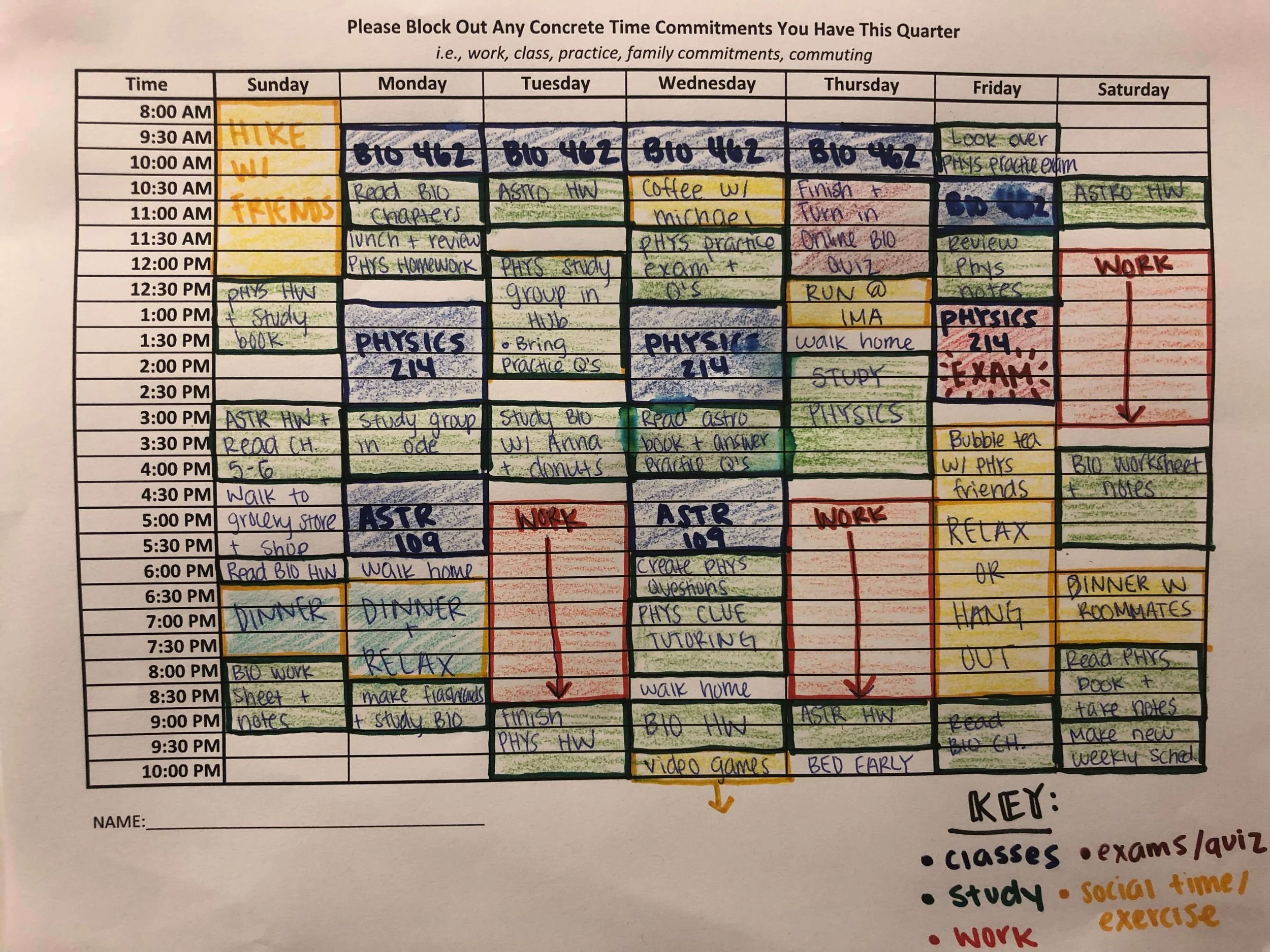
Photo credit: University of Washington Academic Support
5. Prioritize Breaks
Taking breaks is different from scheduling extra-curriculars or fun activities. Beyond planning things you enjoy, it’s essential to take a few minutes away from studying and other work to:
Walk or stretch your legs, back, and neck after sitting for too long
Shut your eyes or refocus them on different distances to ease the strain of reading
Chat briefly with a friend in person or by text to break the solitude
Eat a snack and drink water for an energy boost
These short breaks can ease physical and mental stress, create greater opportunity for focus, and give you perspective when the workload feels heavy. And feeling better will help you stay motivated to complete the task, week, term, or year ahead of you.
6. Minimize Distractions
You might notice that social media, YouTube, Netflix, and similar break options aren’t included above. While it’s okay to scroll a bit or watch a short video when you need to disconnect from your work, try not to let this become constant distractions that don’t serve you well.
In fact, research shows that consuming short-form videos reduce theta brainwave activity in the frontal cortex – the part of the brain responsible for focus and productivity.
If you value social media or watching videos and shows, add this time into your schedule rather than using them as breaks from your work.
7. Make Healthy Choices
I know, I know – you’ve heard this a million times! But it’s true: your body needs healthy foods, lots of water, regular movement, and consistent sleep to maintain energy and focus. If you’re regularly grabbing fast food and caffeine on the way to class, sitting for hours with poor posture, and catching up on missed sleep in class or on the desk at the library, you’ll inevitably become run-down, exhausted, and unmotivated.
Does this mean you need to become some kind of health guru? Absolutely not! But a few small changes can make a notable effect on your ability to engage with all the things you want to do with your time. If you can’t do these each day, then try for most days during the week.
Start your day with a full glass of water, a serving of protein, and a piece of fruit.
Carry a water bottle so staying hydrated is easy.
Keep your caffeine intake to before lunch.
Choose fresh, quick snacks when you can – fruit, cheese, nuts, hard boiled eggs, yogurt, smoothies, granola, etc.
Stand up every hour or so to stretch or take a short lap.
Get in 30 minutes of movement most days.
Avoid studying on your bed or in your room – save this space for relaxation and sleep.
Try to get most of your sleep at night and keep a consistent sleep routine.
When you feel tired during the day, drink water, get up and move, change study topics, listen to music or a podcast, or talk to someone.
8. Celebrate Your Wins
Rewarding yourself for your accomplishments is critical to staying motivated in college. I mentioned this when discussing treating yourself when working towards your goals, but it applies much more broadly here. When you celebrate your wins, your brain releases dopamine, a hormone that contributes to feeling pleasure and enjoyment. That “feel-good” response encourages you to repeat the behavior, creating a natural cycle that supports motivation for college students.
Here’s the key: this cycle requires celebrating all wins, no matter how big or small. If you only celebrate your monumental wins, like getting the grades you want at the end of the term, earning a leadership position in a club or organization, submitting a major research project, or graduating, then your reward cycle will be infrequent because these events take time.
The big accomplishments require you to be motivated, so celebrating the smaller wins along the way are essential. These might include attending weekly study sessions to keep your grades up, submitting the application for the leadership position, meeting the steps required for the research project, and completing each term on your way to graduation. Even smaller but still meaningful wins may be getting to class on time, passing a test, going to the gym twice a week, receiving positive feedback from a professor, and getting to bed on time, and so many more.
Ultimately, acknowledging your progress — or even throwing a party for them — helps you develop and maintain your motivation. College is hard. You have earned your wins and deserve to celebrate all of them.
9. Lean on Support Systems
Every student needs support, especially when you’re feeling overwhelmed and unmotivated. You may feel like you’re the only one struggling, especially if other students have an outward appearance that makes it seem like they have it all together. In reality, many students struggle in similar ways, which is why colleges offer various support services to help students stay motivated and on track.
Trying to push through on your own can feel like the “strong” thing to do, but real strength often means knowing when to ask for help. If you’re feeling overwhelmed or unmotivated, take advantage of the support systems available to you.
Depending on what you’re struggling with, consider these support systems:
Family - Even if they don’t understand all the details of your college experience, your parents/guardians, siblings, or other family members are often great sources of general support. Even just talking to a familiar person can offer motivation.
Friends - Studying, taking breaks, and venting with friends may be just what you need when you find your energy and motivation waning. But make sure you’re moving each other forward and not reinforcing each other’s lack of motivation!
Doctors/therapists - If you have a physician and/or therapist who helps you through challenging times, you may be able to continue seeing them while you’re at school. Many health professionals are willing to meet online, so be sure to ask about this.
Upper level students - If you’re a first or second year student, look to juniors and seniors you know for advice and guidance. They’ve been there, done that! Look for people you know from clubs, residence halls, or other campus activities.
Professors - Connect with your professors during their office hours, before or after class if appropriate, or by email. It can be intimidating to engage with professors, so I recommend introducing yourself early in the term when things are relatively easy so that you feel more comfortable getting their help when things get a bit more difficult.
Academic advisors - Most departments on campus have at least one advisor to provide all kinds of academic support. Make an appointment or send an email if you need advice about classes, professors, or anything else. If they can’t help you, they’ll probably know who can.
Campus support centers - Many campuses offer dedicated spaces to support both your academic work and sense of belonging. Writing and tutoring centers provide one-on-one help when you’re feeling stuck on assignments. Cultural and identity centers offer connection, guidance, and community for specific student populations.
Counseling - On-campus counseling centers are very common and often offer one-on-one and group sessions to help you stay on top of your well-being and motivation. These services can help you manage stress, protect your energy, and stay focused during challenging times.
Coaching services - If you want support that’s separate from your campus environment, college coaching can offer an objective, outside perspective. At The Confident Undergrad, students can access 1:1 virtual coaching, group coaching on topics like time management and imposter syndrome, and self-paced courses. A free consultation can help you decide if coaching is the right fit.
Motivational Quotes for College Students
Sometimes the right words at the right time can help you reset, breathe, and keep going. Consider saving a few of these quotes somewhere you’ll see them regularly to support your motivation throughout the semester.
“Start where you are. Use what you have. Do what you can.” — Arthur Ashe
“When one door closes, another opens; but we often look so long and so regretfully upon the closed door that we do not see the one which has opened for us.” — Alexander Graham Bell
“Great things are done by a series of small things brought together.” — Vincent van Gogh
“Every expert was once a beginner.” — Helen Hayes
“I’ve failed over and over and over and over again in my life. And that is why I succeed.” — Michael Jordan
“Your talents and abilities will improve over time, but for that, you have to start.” — Martin Luther King Jr.
“Courage doesn’t always roar. Sometimes courage is the quiet voice at the end of the day saying, ‘I will try again tomorrow.’” — Mary Anne Radmacher
“Dream big, but start small. The smallest step in the right direction can end up being the biggest step of your life.” — Unknown“Success is not final, failure is not fatal: it is the courage to continue that counts.” – Winston Churchill
“Perseverance is not a long race; it is many short races one after the other.” – Walter Elliot
“Do anything, but let it produce joy.” – Walt Whitman
“Just don’t give up trying to do what you really want to do. Where there is love and inspiration, I don’t think you can go wrong.” – Ella Fitzgerald
Quote sources: Sunshine and Rainy Days & CollegeRaptor
How to Stay Motivated in College: Conclusion
Staying motivated in college becomes easier when you understand what matters to you, create simple routines, and give yourself space to rest and celebrate your progress. Aim for small steps, not perfection, to carry you forward.
If you’d like help applying these tools, I offer 1:1 coaching and group workshops designed to help college students feel more capable, organized, and supported. Explore these offers here or reach out to inquire about working together.